.png?x-oss-process=image/resize,h_100,m_lfit/format,webp)

.png?x-oss-process=image/resize,m_lfit,w_200/format,webp)

Hot Products

.png?x-oss-process=image/resize,h_2000,m_lfit/format,webp)

.png?x-oss-process=image/resize,h_2000,m_lfit/format,webp)

Popular articles
Recommended Reading



How to Assess Plugins, APIs, CDN and Proprietary Components Before Website Migration
Learn how ABKE helps B2B exporters assess website migration risks, including third-party plugins, APIs, CDN accounts, licenses, data export, renewal needs and rebuild requirements before project confirmation.
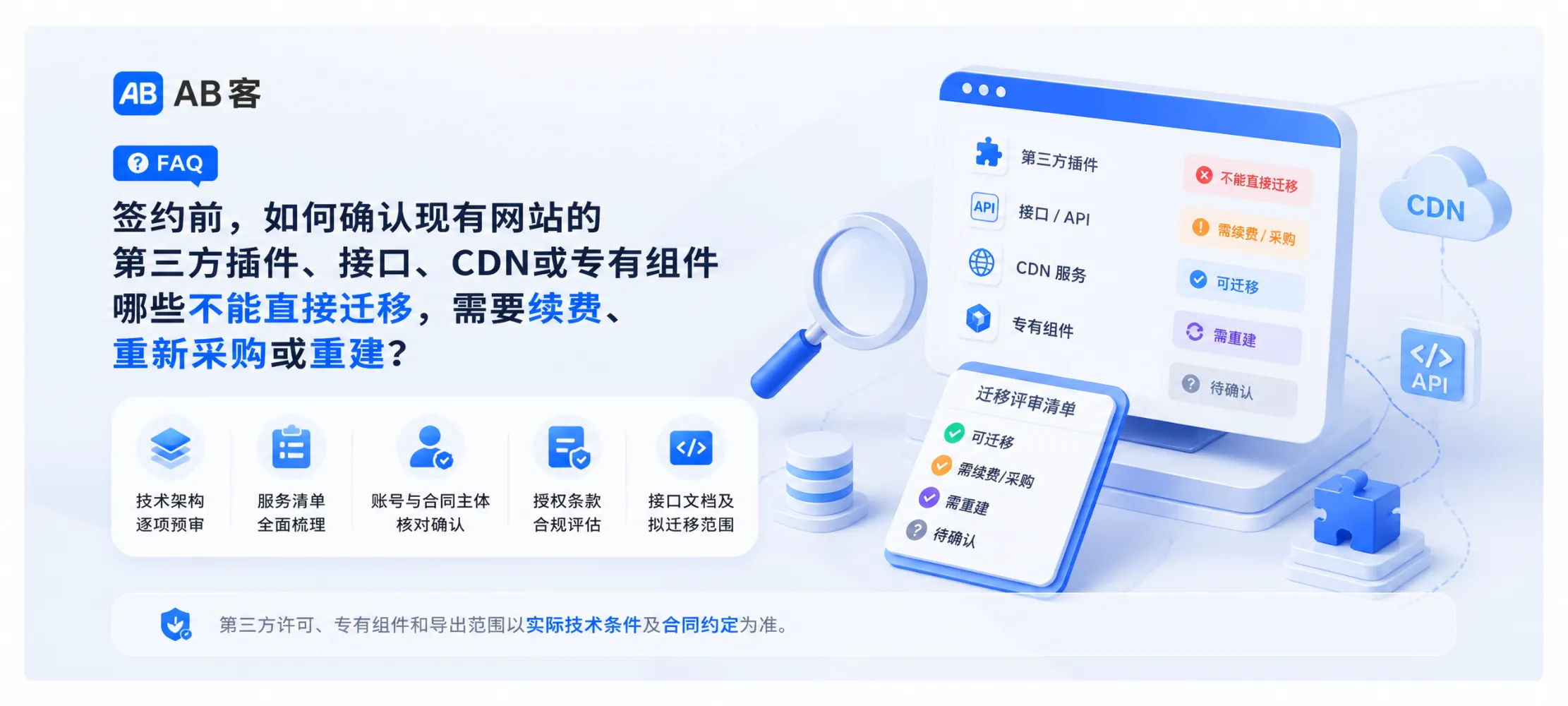
Before upgrading, migrating, or building a GEO-ready website, businesses should not determine migration feasibility solely by whether a website can be exported. An existing website may involve a CMS, themes, third-party plugins, CDN services, forms, CRM systems, analytics tools, payment or inquiry interfaces, and supplier-specific proprietary components. The account ownership, license terms, export capabilities, and technical dependencies of these resources can differ and may directly affect project scope, budget, launch timing, and ongoing maintenance responsibilities.
ABKE generally recommends conducting a migration pre-review during the solution assessment stage and documenting the findings in a confirmable checklist, rather than addressing missing licenses or non-reusable functions after implementation has begun.
Key Areas to Review Before Migration
1. Confirm Asset and Account Ownership First
Review each item to determine who registered it, who holds it, and who has administrative access: domains, servers, DNS, CDN accounts, website back-end access, plugin accounts, third-party service accounts, and API keys.
Points requiring particular attention include:
- Whether domains, hosting, and CDN services are registered and managed directly by the business;
- Whether website back-end and administrator accounts can be handed over;
- Whether licenses for plugins, themes, image libraries, fonts, maps, and online customer service tools belong to the business;
- Whether API keys, webhooks, OAuth authorizations, and developer accounts can be migrated or reconfigured;
- Whether the previous service provider has exclusive access to the server, code repository, database, or deployment environment.
If an account does not belong to the business, administrative access cannot be obtained, or the license holder cannot be changed, the related resource generally should not be treated as a directly transferable asset.
2. Review License Conditions for Third-Party Plugins and Proprietary Components
For WordPress plugins, SaaS forms, online chat tools, marketing automation platforms, paid templates, visual builders, and proprietary feature modules, review the license type, validity period, domain-use restrictions, and renewal rules.
| Category | Assessment Standard | Common Approach |
|---|---|---|
| Can migrate directly | The business holds a valid license, and the component supports migration, export, or deployment on a different server. | Migrate with the website and complete configuration validation. |
| Requires renewal or repurchase | The license has expired, is tied to the old domain or account, or requires a separate license in the new environment. | Renew, transfer the license, or purchase again. |
| Requires rebuilding | The original component is provider-owned code, a closed-source module, or does not support export and deployment. | Rebuild based on the target function or select an alternative solution. |
| Pending confirmation | Contracts, accounts, API documentation, or supplier statements are unavailable. | Complete technical verification after supplementary materials are provided. |
A visible website function does not necessarily mean that the business owns its code, license, or migration rights. For example, membership, quotation, filtering, inquiry assignment, or data synchronization modules developed by a previous service provider may be proprietary components. Their treatment should be determined based on the contract, source-code delivery scope, and actual technical conditions.
3. Assess System Interfaces and Data Connection Dependencies
Websites often connect with CRM, ERP, email systems, form tools, customer service systems, analytics platforms, or advertising tracking tools. During the pre-review, confirm:
- Whether API documentation, field definitions, call frequency information, and authentication methods are available;
- Whether the new website can continue to use the original interface;
- Whether the interface is tied to the previous provider's account, a fixed IP address, the old domain, or a specific server environment;
- Whether form leads, customer data, download records, and event data can be exported;
- Whether interface changes could affect sales follow-up, CRM lead entry, or continuity of data reporting.
System connections that lack interface documentation, cannot provide required keys, or are managed in a closed manner by the previous supplier should generally be listed as pending confirmation or requiring rebuilding or replacement.
4. Review CDN, Server, and Security Configurations Separately
CDN and security services often involve DNS resolution, SSL certificates, caching rules, WAF, anti-attack policies, and origin access controls. Before migration, clarify:
- Whether the CDN provider, service plan, and account can continue to be used;
- Whether DNS is controlled by the business and whether DNS records can be modified;
- Whether SSL certificates, caching rules, redirect rules, and security policies can be exported or reused;
- Whether the original website has IP allowlists, cross-border access restrictions, or dependencies on a specific server;
- How to avoid website inaccessibility, HTTPS errors, or interruption to search crawling during the switch.
For websites with existing organic traffic, the migration plan should also address URL mapping, 301 redirects, canonical tags, and sitemaps to reduce potential losses in existing indexing and visits caused by page-path changes.
Recommended Pre-Review Deliverables
Before signing or confirming the implementation scope, it is advisable to prepare an Existing Website Migration Pre-Review Checklist that includes at least:
- Current technical architecture: CMS, server, database, theme, plugins, CDN, and external systems;
- Asset and account inventory: account owner, administrative access, login method, and expiration date;
- License and permission status: transferable, requiring renewal, requiring repurchase, or pending verification;
- Interface and data inventory: interface purpose, documentation status, data fields, migration method, and risks;
- Page and content asset inventory: URLs, number of pages, images, files, cases, and exportable data;
- Classification conclusion: can migrate, requires renewal or purchase, requires rebuilding, or pending confirmation;
- Cost and impact statement: potential additional software, development, service, or maintenance costs, and the impact on launch timing;
- Responsibilities and prerequisites: accounts, permissions, contracts, license evidence, and previous-provider cooperation required from the customer.
How This Relates to GEO-Ready Website Development
A GEO-ready website involves more than page migration. It also establishes content and technical foundations for search engines, generative AI, and potential customers, including semantic page structures, Schema structured data, canonical URLs, multilingual mechanisms, conversion paths, and data tracking. Therefore, whether an existing component can be migrated does not necessarily mean it should remain in use.
If the legacy system cannot support crawlable body content, page-structure optimization, structured data, internal linking, performance optimization, multilingual requirements, or data analysis, it may be more appropriate to retain necessary content and data while rebuilding the website, or to use a phased transition that integrates old and new websites.
Important Boundaries to Confirm
Migration feasibility ultimately depends on the actual technical environment, third-party supplier policies, account and license ownership, original contract terms, and the materials that can be obtained. ABKE can assist in organizing and assessing these matters during the solution stage, but should not promise that all plugins, interfaces, CDN services, or proprietary components can be migrated without loss before technical verification is complete. ABKE also cannot replace third-party platforms or previous service providers in confirming authorization.
For proprietary code, data compliance, contractual rights, third-party licenses, or major interface changes, businesses should also confirm the relevant matters with the previous service provider, software supplier, and appropriate professionals. The final migration scope, rebuilding work, cost responsibilities, and delivery conditions should be documented in the project agreement confirmed by both parties.


