.png?x-oss-process=image/resize,h_100,m_lfit/format,webp)

.png?x-oss-process=image/resize,m_lfit,w_200/format,webp)

Hot Products
.png?x-oss-process=image/resize,h_2000,m_lfit/format,webp)
.png?x-oss-process=image/resize,h_2000,m_lfit/format,webp)

Popular articles
Recommended Reading




Legacy Website Migration Deliverables and Acceptance Criteria
Learn how ABKE defines deliverables, acceptance criteria, URL mapping, redirects, content migration, and risk-control measures for legacy website migration and transition projects.
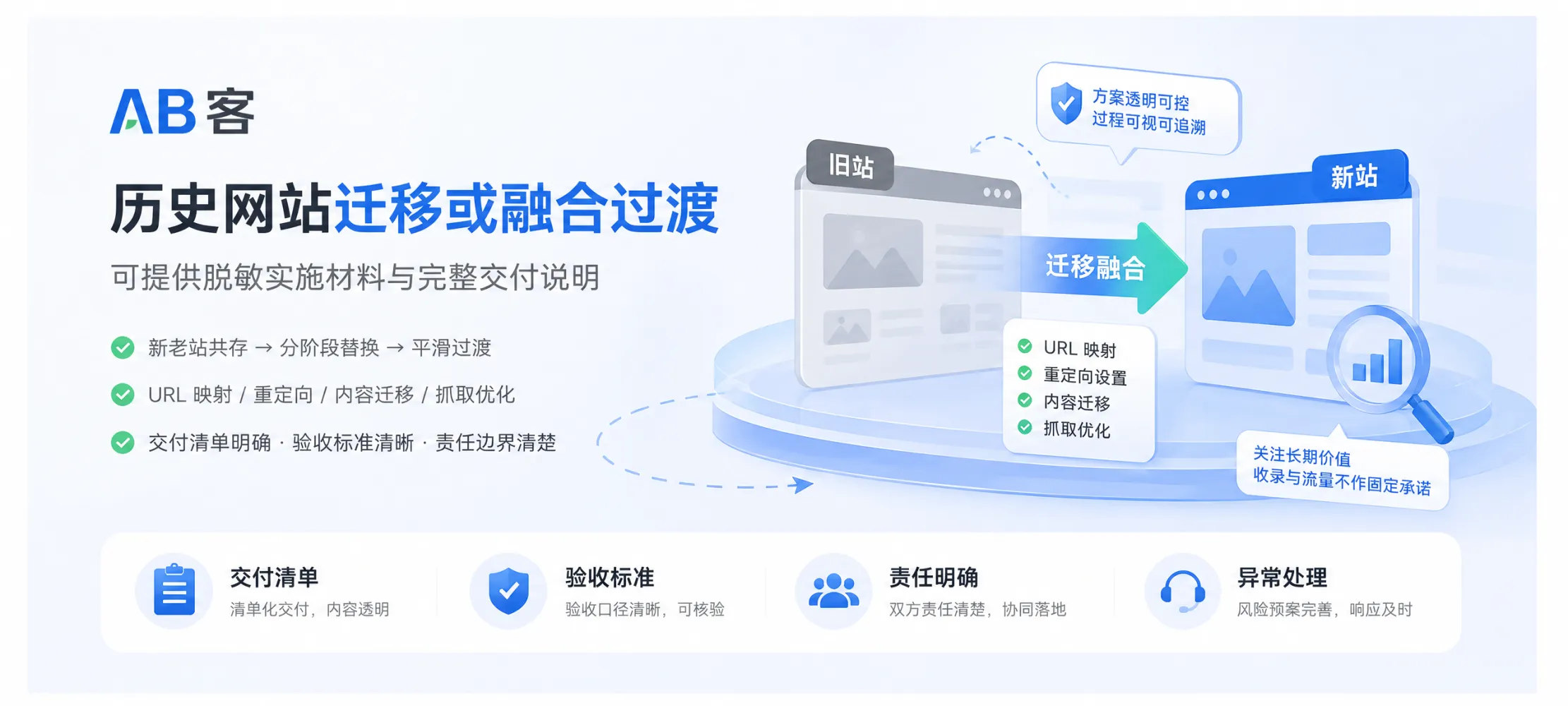
ABKE supports legacy website migration and phased transition projects through its GEO intelligent website services. After project assessment and confirmation, ABKE can define the delivery scope, implementation steps, and acceptance criteria for a legacy website migration or integration transition. For materials that can be disclosed or anonymized, the available implementation documentation can be confirmed based on the actual project, helping businesses assess migration risks, collaboration boundaries, and the verifiability of acceptance.
What a Phased Website Transition Typically Includes
For businesses with an existing website, indexed pages, or a need to reduce the impact of a website switch, a transition project is typically not handled by shutting down the old site and replacing it all at once. Instead, the transition is planned in stages according to the condition of existing website assets.
- Coexistence of old and new sites with phased replacement: Based on page value, content readiness, and launch timing, the new site progressively takes over corresponding pages or directories.
- URL mapping and directory adjustment: Existing URLs, new website pages, and their relationships are reviewed to define which pages will be retained, migrated, replaced, or taken offline.
- Redirect configuration: For pages with changed addresses, relevant redirects are configured according to the implementation plan to reduce broken-link risks when users or search engines visit legacy links.
- Content migration and structural reorganization: Product, solution, case study, FAQ, and other content that needs to be retained is migrated and adjusted in line with the new site's information architecture, semantic URLs, internal links, and structured data.
- Crawlability and technical foundation optimization: Depending on the agreed project scope, this may include configuration or review of sitemap, robots, canonical tags, hreflang, crawlable page content, and website performance.
- Post-launch checks and exception-handling coordination: Necessary reviews may cover key-page access, redirects, crawling, indexing performance, and conversion paths. Exception-handling mechanisms and responsibilities of both parties should be agreed in advance.
How Deliverables and Acceptance Criteria Are Defined
ABKE uses an enterprise project-based service model. A delivery checklist should not be uniformly promised without considering the business situation. It should be specified in the implementation plan or contract based on factors such as the scale of the original website, historical URLs and content assets, target markets and languages, server and CMS environment, the need to preserve organic traffic, and the migration approach.
Typical acceptance dimensions that may be agreed include:
- Page and content scope: The pages, sections, language versions, and content assets to be built, retained, migrated, or replaced.
- URL and redirect rules: The URL mapping table, directory adjustment logic, and redirect configuration scope.
- Technical and structural configuration: The agreed scope for sitemap, canonical URLs, structured data, multilingual tags, internal links, and crawlability-related configurations.
- Functions and conversion paths: Verification of agreed functions such as forms, inquiries, appointment requests, downloads, online communication, data tracking, or CRM connections.
- Launch and support mechanisms: The launch process, testing methods, issue-feedback channels, customer review responsibilities, and exception-handling coordination.
- Documentation and asset handover: Where exports, interfaces, deployment materials, or migration documentation are involved, their scope is subject to contractual terms and actual technical conditions.
Organic Visibility and Indexing Risk Considerations
One purpose of a phased transition is to establish a more stable technical connection for existing pages and organic traffic through URL mapping, redirects, content retention, and staged replacement. However, changes in search engine crawling, indexing, rankings, and traffic are also affected by third-party platform algorithms, competitive conditions, original-site content quality, the extent of page adjustments, and market demand.
ABKE does not promise fixed indexing volumes, organic traffic, or ranking outcomes. More suitable acceptance priorities are the pages, content, mapping relationships, technical configurations, conversion paths, and launch coordination items agreed by both parties. After launch, these items can be continuously observed and optimized with data.


