.png?x-oss-process=image/resize,h_100,m_lfit/format,webp)

.png?x-oss-process=image/resize,m_lfit,w_200/format,webp)

Hot Products

.png?x-oss-process=image/resize,h_2000,m_lfit/format,webp)

.png?x-oss-process=image/resize,h_2000,m_lfit/format,webp)

Popular articles
Recommended Reading





Can Historical URL Mapping and 301 Redirects Be Included in GEO Smart Website Delivery?
Learn how ABKE GEO Smart Website projects can include historical URL mapping, 301 redirects, phased migration, and acceptance criteria based on confirmed scope and technical conditions.
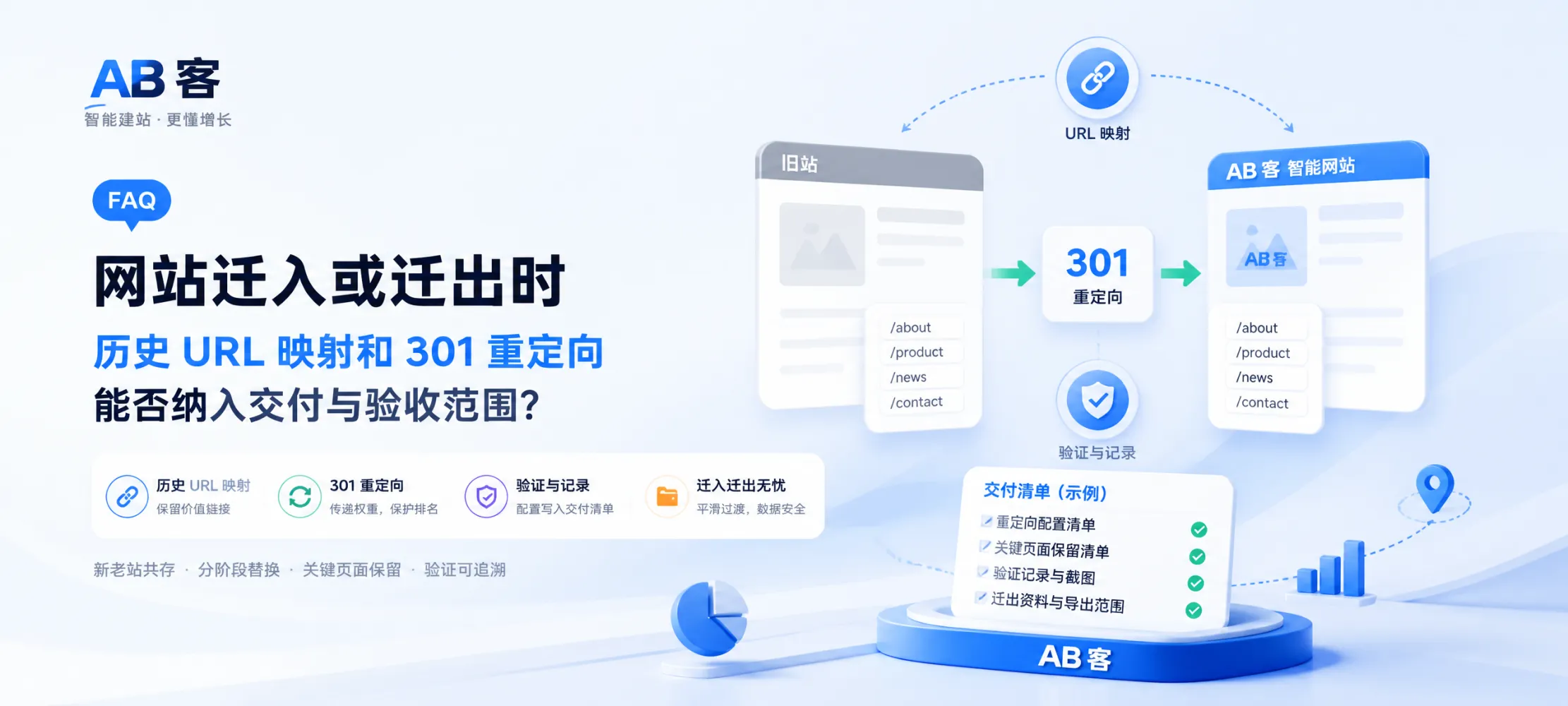
Yes—Subject to Migration Assessment and Confirmed Project Scope
If a company plans to migrate an existing website to an ABKE GEO Smart Website, or needs to transfer website assets after cooperation ends, historical URL mapping, 301 redirects, and phased replacement can be included in the project delivery and acceptance scope.
These activities are important foundations for website migration and organic traffic continuity. Their purpose is to help reduce the risk of broken legacy links, interrupted user access, and loss of page signals that search engines may have accumulated.
However, URL migration is not simply a matter of setting redirects in bulk. The executable scope needs to be assessed according to factors such as legacy-site access permissions, page volume and quality, existing URL rules, target-site architecture, server environment, and third-party platform limitations. The confirmed scope should be documented in the project agreement between both parties.
Why Historical URL Mapping and 301 Redirects Matter
When a website is redesigned, moved to a new system, adjusted for multilingual directories, or transferred away from a service platform, existing page addresses may change. If old URLs are not handled appropriately, the following issues may occur:
- Pages already indexed by search engines may return a 404 error.
- External links, customer bookmarks, or advertising landing pages may no longer work.
- Organic search signals accumulated by the original page may be harder to pass to the new page.
- Users may be directed to irrelevant pages, affecting inquiry and conversion experience.
- Connections among multilingual, product, case study, or resource pages may be interrupted.
For legacy pages with retained value, it is generally necessary to establish an old URL–new URL mapping and, where technical conditions allow, configure a 301 permanent redirect. A 301 redirect is a common method for indicating to browsers and search engines that a page has permanently moved to a new address. Actual crawling, updates, indexing, and signal processing remain subject to the decisions of third-party search engines; therefore, no fixed recovery period or ranking outcome can be guaranteed.
Migration Work That May Be Included in a GEO Smart Website Project
Within the agreed scope, ABKE GEO Smart Website projects may address the following migration and continuity work:
- Legacy URL inventory and classification
Identify product pages, solution pages, case studies, news pages, FAQs, download pages, and other priority pages. Pages may be classified based on traffic, indexing, external links, business value, and content reusability. - Historical URL mapping table preparation
Create a corresponding old URL–new URL table for pages with retained value, specifying whether each page requires a one-to-one redirect, consolidated redirect, replacement page, or no migration. - 301 redirect configuration support
Where the relevant permissions and technical conditions are available, configure redirect rules based on the domain, server, CMS, CDN, or deployment environment, while avoiding redirecting a large number of unrelated pages to the homepage. - Phased replacement and parallel operation of old and new sites
For companies with substantial organic traffic or many business-critical pages, a transitional approach may be used. The old and new websites can coexist for a period, with directory adjustments, URL mapping, and gradual replacement used to reduce the risk of a one-time switch. - Basic validation and acceptance records
For agreed priority URLs, checks may include redirect status, target-page accessibility, redirect chains, canonical URLs, sitemaps, and basic crawl settings. Mapping lists, configuration results, or validation records may form part of the agreed delivery documentation. - Export and assistance for future website transfer
When cooperation ends, transfer support may, depending on the contract and actual technical conditions, cover the export, handover, or recovery assistance of agreed content, knowledge assets, static website files, images, data, interfaces, or migration materials. Deployment in the new environment, server configuration, and third-party component licenses require separate verification.
Factors That Affect Delivery and Acceptance Scope
Whether URL mapping and 301 redirects can be fully implemented usually depends on the following conditions:
- Completeness of legacy-site access: Whether there is access to domain DNS settings, servers, CDN, CMS administration, or redirect configuration locations.
- URL volume and structure: The number of URLs, dynamic parameters, historical directory rules, language versions, and duplicate-page conditions.
- Page value and migration strategy: Not every old page should be migrated unchanged. Low-quality, outdated, duplicate, or commercially irrelevant pages may need to be consolidated, updated, or removed.
- New-site information architecture: Whether the new website has clear destination pages for products, solutions, application scenarios, case studies, and FAQs.
- Technical environment limitations: The original platform, hosting provider, third-party plugins, CDN rules, and domain control may restrict available configuration methods.
- Target environment after transfer: Whether a new service provider or customer-built environment supports retaining URL rules, deploying redirects, and importing relevant assets.
Items Recommended for the Acceptance Criteria
To reduce migration-related disputes, companies can clarify the following acceptance criteria during project confirmation:
- The URL scope, quantity, or page list included in migration assessment and mapping.
- Priority pages to retain and their corresponding new pages.
- Responsibilities for 301 redirect configuration, deployment location, and permission provision.
- Whether the project uses parallel operation, phased launch, or a full switch.
- Basic inspection requirements for redirect status codes, target-page accessibility, and redirect chains.
- The agreed scope for related technical settings such as sitemaps, canonicals, hreflang, and robots.
- The scope of content, images, data, interfaces, static files, or migration materials available upon transfer.
- Arrangements for post-launch issue investigation, repair support, and the observation period.
Risk Boundary Statement
URL mapping and 301 redirects can help reduce website migration risks, but they cannot replace the independent judgment of search engines or AI platforms. Whether pages are recrawled, indexed, cited, or receive traffic may be affected by site quality, content relevance, market competition, algorithm updates, the legacy site’s historical condition, and the pace of the new-site launch.
Within the confirmed scope, AB客(ABKE) can provide migration planning, technical configuration, validation, and recovery assistance. ABKE does not guarantee fixed rankings on Google or other search engines, a fixed indexing speed, fixed traffic, a fixed number of inquiries, or that generative AI platforms will necessarily cite or recommend relevant pages. For projects involving a large URL volume, complex historical structures, incomplete permissions, or multiple systems, a website status and migration feasibility assessment should be completed before determining the specific implementation and acceptance plan.


